The Boulder Conference: Contributions to Psychology

The Event:

In summer 1949, 73 individuals from psychology and related fields came together for the first a national meeting to consider standards for doctoral training at conference at the University of Colorado, Boulder. The conference produced a model known as the ‘Boulder model’ or ‘scientist-practitioner’ model, arguing the possibility and reliability of training clinical psychologists as competent practitioners as well as scientists (Freedheim & Weiner, 2003).

Background to Event

Clinical psychology changed dramatically because of the two world wars. With Psychiatry being unable to handle the overwhelming caseload of soldiers being affected both physical and mentally, Psychology was turned to for help (Baker, 2016).

Shortly after World War 2 ended, the US government launched programs to enhance the training of clinical psychologists. The increase of these opportunities for clinical psychologists led to a realisation that no standardised training program existed (Baker, 2016).

In 1941, David Shakow drafted a report with his training recommendations. He was then the chief psychologist at Worcester State Hospital in Massachusetts and regarded as an authority in the study of schizophrenic disorders Shakow was also the major psychology consultant to the NIMH, giving his ideas enormous influence both with the NIMH as well as the APA, the conference sponsor (Pickren & Rutherford, 2010).

The Boulder conference was held under Shakow’s leadership, producing a training model still relevant today (Baker, 2016) and referred to as the Boulder model. The model was developed from the earlier template laid out by Shakow and then expanded by the Committee on Training in Clinical Psychology. It emphasised the importance of training clinical psychologists to be scientists first, practitioners second (Pickren & Rutherford, 2010).

Clinicians trained according to this model would complete a research-based Ph.D. dissertation in a graduate school environment, while they were also becoming experts at the diagnosis of mental illness and its treatment (Baker, 2016).

Contributions to psychology:

The Boulder conference endorsed the model that allowed for more universities to establish clinical psychology training programs (Pickren & Rutherford, 2010). It solidified clinical psychology’s identity as separate from psychiatry (Woody & Viney, 2017).

By the early 1960s, clinical psychologists identifying primarily as practitioners argued that the model did not adequately prepare clinical psychologists for the actual practice which included assessment, diagnosis, and psychotherapy. They argued it was overly medicalised, ignoring the role of social structural elements (Pickren & Rutherford, 2010).

A second approach was proposed, leading to another conference in Vail, Colorado in 1973. The Vail model, also called the practitioner-scientist model’ included research training but placed a heavy emphasis on practice. This training led to a PSy.D. instead of a Ph.D. (Baker, 2016). Baker & Benjamin (as cited in Baker, 2016, p. 589) stated that today, the APA today credits both programs, but the Boulder program out numbers the Vail program by about three to one.

Baker & Benjamin (as cited in Baker, 2016, p. 361) also state that the Boulder conference produced more than the Boulder model, it gave national policy makers the assurance that professional applied psychology could meet the mental health needs of the nation. The conference also allowed for ethical guidelines for practicing therapists, with the APA adapting a Code of Ethical Standards of Psychologists. Several journals such as the Journal of Clinical Psychology, the Journal of Counselling Psychology also emerged (Woody & Viney, 2017).


References

Baker, D.B. (2016). Oxford Handbook of the History of Psychology: Global Perspectives. New York, NY: Oxford University Press.

Freedheim, D.K. & Weiner, I.B. (Eds.). (2003). Handbook of Psychology: History of Psychology. New Jersey, NJ. John Wiley & Sons.

Pickren, W. & Rutherford, A. (2010). A History of Modern Psychology in Context: Incorporating Social, Political, and Economic Factors into the Story. New Jersey, NJ: John Wiley & Sons.

Woody, W. D. & Viney, W. (2017). A History of Psychology: The Emergence of Science and Applications. (6th ed.). New York, NY: Routledge.

James McKeen Cattell (1860 – 1944): Increasing Psychology’s Recognition as a Discipline

423px-James_McKeen_Cattell

James McKeen Cattell (Library of Congress, n.d.).

Early Life:

James M. Cattell was born in 1860 in Pennsylvania. His father, William C. Cattell was the president of Lafayette College where Cattell began his formal studies in 1876 and thrived academically (Sokal, 2015).

Cattell’s father experienced anxiety issues despite his achievements and looked to his wife and Cattel to ease his anxiety. Cattell thrived in this close-knit family setting (Sokal, 2015). His family played a great role in his life and career.

Influences and Pursuits:

Cattell graduated with honours from Lafayette College (Woody & Viney, 2017). His undergraduate interests centred largely on literature (Woodworth, 1944). At Lafayette, Cattell’s scientific views were influenced by Francis A. March a teacher in mental philosophy and Francis Bacon, who emphasised the utility of knowledge and the collection of masses of empirical details (Sokal, 2015).

After graduating, Cattell spent two years in Germany, studying with philosopher Herman Lotze and then with Wilhelm Wundt in Leipzig.

Cattell attained a fellowship at Johns Hopkins in Baltimore. He became interested in laboratory science, enrolling in H. Newell Martin’s animal physiology course and G. Stanley Hall’s psychology course and worked in their laboratories. Cattell discovered he was skilful with instruments, devising and building apparatuses (Sokal, 2015). He began his psychometric investigations in Hall’s psychological laboratory and conducted experiments using a modified kymograph (Sokal, 2015).

Cattell left Baltimore to study with Wilhelm Wundt in Leipzig, after his fellowship was not renewed. He became the first American to earn a Ph.D. in experimental psychology from Wundt (Sokal, 2015).

Cattell then worked with Francis Galton in England. Galton’s interest in the measurement of bodily and mental attributes influenced Cattell greatly (Woody & Viney, 2017).

Cattell later returned to the United States to accept an appointment at the University of Pennsylvania (Woody & Viney, 2017), becoming the first psychology professor in the US.

Contributions to Psychology:

Cattell increased psychology’s recognition as a professional and scientific discipline. He established laboratories at the University of Pennsylvania and at Columbia University, building strong graduate programs in psychology with Thorndike and Woodworth being some of his students (Woody & Viney, 2017).

Cattell was interested in introducing quantitative methods into psychology, particularly for the measurement of individual differences (Woodworth, 1944). His research programmes focused on the development of mental tests, a term in coined. In Cattell’s day, measuring mental abilities was thought to be helpful for schools and industry. Cattell’s approach was later disputed, ending his career as a psychological tester. Alfred Binet’s different strategy to tests however showed more promise (Woody & Viney, 2017).

Cattell expressed his strong opinions on many issues, with his criticisms of key political and university officials leading to his dismissal from Columbia University (Woody & Viney, 2017).

Cattell worked as an editor of several journals including the journal Science, where he featured psychological articles alongside research from more established scientific disciplines and brought the work of psychologists to the attention of other scientists and the public. He alongside James Mark Baldwin founded two major journals in psychology, the Psychological Review and Psychological Bulletin. Cattell also created the Psychological Corporation to provide psychological expertise to business and industry and served as the 4th president of the APA (Woody & Viney, 2017).

References:

Library of Congress (n.d.). American psychologist, psychology professor, editor, and publisher James McKeen Cattell. Retrieved December 4, 2018 from https://commons.wikimedia.org/wiki/File:James_McKeen_Cattell.jpg#/media/File:James_McKeen_Cattell.jpg

Sokal, M.M. (2015). Launching a career in psychology with achievement and arrogance: James McKeen Cattell at the Johns Hopkins University, 1882-1883. Journal of the History of the Behavioural Sciences, 51, 5-19. https://doi.org/10.1002/jhbs.21764

Woodworth, R.S. (1944). James McKeen Cattell: 1860 – 1944. The Psychological Review, 51, 201 – 209.

Woody, W. D. & Viney, W. (2017). A History of Psychology: The Emergence of Science and Applications. (6th ed.). New York, NY: Routledge.


Establishment of the First Psychology Laboratory

Capture

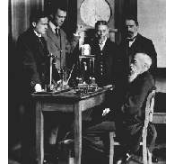
Wilhelm Wundt and his assistants (University of Leipzig, n.d.).

The Event:

In 1879, Wilhelm Wundt (1832 – 1920) established the first laboratory dedicated to psychology research, at the University of Leipzig in Germany. This event marked the official birth of psychology as an independent field of study, transitioning psychology from philosophy to science and led to the launch of a new discipline that would become international in scope (Woody & Viney, 2017).

Background to the Event:

Several factors contributed to this event.

By the end of the 19th Century, the experiment became the method of discerning truth, and the laboratory, the place where truth, through experimentation was discovered. Physiologists such as Flourens and Johannes Muller supported the argument for experimental, laboratory-based investigation. This opened a line of research in physiology, leading directly to Herman von Helmholtz and Wilhelm Wundt and helping make a physiologically based psychology possible (Pickren & Rutherford, 2010).

Wundt was a product of the open German intellectual tradition. For Germans, science was not determined by its subject matter, but rather a way of looking at things, or Wissenchaft. It was thought that any topic could be approached in a scientific manner (Pickren & Rutherford, 2010).

Wundt acknowledged the earlier contributions from disciplines such as physics, physiology and philosophy. Having obtained a degree in medicine, Wundt followed up his interest in research by doing post-doctoral work under Johannes Muller and Emil Du Bois-Reymond and also working as Helmholtz’s assistant in his physiological laboratory. Wundt’s research interests shifted from physiology to psychology and he secured an appointment at the University of Leipzig due to his growing reputation in psychology (Woody & Viney, 2017).

Wundt proposed a new field, experimental psychology, aimed at bringing together physiology and psychology by combining the methods of experimental physiology with psychological introspection to study the processes of sensation and voluntary movement (Pickren & Rutherford, 2010). Wundt’s method of study, also used in his laboratory, came to be known as experimental introspection, distinguished through the introduction of the laboratory apparatus, standardising presentations of stimuli for subjects to respond to.

Wundt stated that experimental introspection was less useful for complex processes such as thought and language. He saw the limitations of experimentation and placed a large and important segment of psychology in human or cultural science rather than natural science (Pickren & Rutherford, 2010).

The event’s contribution to Psychology:

In Wundt’s laboratory, psychology was first practiced as the organised and self-conscious activity of a community of investigators, collaborating in pursuit of scientific explanations of mind. This contrasted with the solitary investigations of Wundt’s predecessors and contemporaries including Helmholtz, Fechner and Hermann Ebbinghaus (Benjamin, 2000).

The fame of Wundt’s laboratory spread in the United States, attracting many American students, particularly G. Stanley Hall. Hall spent some time with Wundt but worked principally in the physiological laboratory of Carl Ludwig. In 1883, Hall founded what is recognised as the first psychology laboratory in America at Johns Hopkins University.

Today, the psychology laboratory still exists in most academic and non-academic settings, although, the computer has replaced the diverse brass instruments and specimen jars originally used. Psychology faculty and students continue to be involved in laboratory training, and laboratory investigators remain plentiful in psychology (Benjamin, 2000).


References

Benjamin, L. T. (2000). The psychology laboratory at the turn of the 20th century. American Psychologist, 53, 318-321.

Pickren, W. & Rutherford, A. (2010). A History of Modern Psychology in Context: Incorporating Social, Political, and Economic Factors into the Story. New Jersey, USA: John Wiley & Sons.

University of Leipzig, Department of Psychology. (n.d.). History of Psychology in Leipzig, Germany. Retrieved from http://psychologie.biphaps.uni-leipzig.de/hist_eng.html

Woody, W. D. & Viney, W. (2017). A History of Psychology: The Emergence of Science and Applications. (6th ed.). New York, NY: Routledge.


Ivan Petrovich Pavlov (1849-1936) : Influences on his life and his contribution to the study of psychology

Early Life:

Ivan Pavlov, a Russian physiologist, was born in a small Russian village in 1849. His father was a priest and an educated man. Pavlov began formal schooling at 11. He sustained an injury as a child and had trouble concentrating on academic matters. Pavlov acquired substantial knowledge on natural history and a good range of manual skills from helping his father in the garden and his mother around the house. Pavlov later put down his enthusiasm for the experimental aspect of physiology to the chores he did as a child (Harre, 2006).

Influences & Pursuits:

Pavlov’s interest in natural science was encouraged by his teachers at the Ryaxan Theological seminary. He began to immerse himself in the writings of progressive thinkers including the radical Russian author, Dmitrij Ivanovich Pisarev (1840 – 1868), whose political vision was dominated by the idea of using science to free society of its ills; and the Englishman Samuel Smiles (1812 – 1904), who supported a disciplined approach to science.

Pavlov was influenced by Ivan Sechenov (1829 – 1905), the founder of modern physiology who believed that psychology could become scientific by embracing objective methods and avoiding references to the mind (Pickren & Rutherford, 2010).

After starting work in the field of science, a series of events followed leading Pavlov to a period of extreme poverty. Pavlov was unable to afford an apartment and at one time could only manage enough money to transport his sickly son to relatives living in the south.

Following these events, Pavlov became indifferent to the political tides of the time, including the revolution of 1917. However, his love for laboratory research did not diminish. Cuny (as cited in Harre, 2006, p.5) stated ‘’once, when Pavlov was utterly destitute, his students collected a fund for his everyday needs, but he spent the money on experimental animals’’.

Contribution to Psychology:

Pavlov conducted a series of experiments on dogs. Through this, he demonstrated how the manipulation of environmental variables could control behaviour. The dogs began salivating when a bell rang, even without food being presented. Pavlov concluded that dogs could be conditioned to unconsciously associate neutral, unrelated events with being fed. This is termed classical conditioning.

Classical conditioning formed the basis of the behaviourist approach, leading to a new way of studying human behaviour. Pavlov’s work influenced that of notable behaviourists such as John Watson and B.F Skinner.

Watson’s study on Albert, an 11-month-old infant child, concluded that humans could be conditioned to fear. Skinner introduced the idea of operant conditioning where aspects of behaviour can be influenced by reward.

Behaviourism’s theoretical goal is the prediction and influence of behaviour, introspection does not form an essential part (Watson, 1931). Mary Whiton Calkins (1863 – 1930) echoed the thoughts of many of her colleagues by suggesting that psychologists should not totally discard of introspection, but rather study the conscious self in relation to its environment (Pickren & Rutherford, 2010).


References

Harre, R. (2006). Key thinkers in psychology. London, UK: Sage Publications. http://dx.doi.org.ezproxy.rgu.ac.uk/10.4135/9781446211977.n1

Pickren, W. & Rutherford, A. (2010). A History of Modern Psychology in Context: Incorporating Social, Political, and Economic Factors into the Story. New Jersey, USA: John Wiley & Sons.

Watson, J. B. (1931). Psychology as the behaviourist views it. Psychological Review, 20, 158-177.