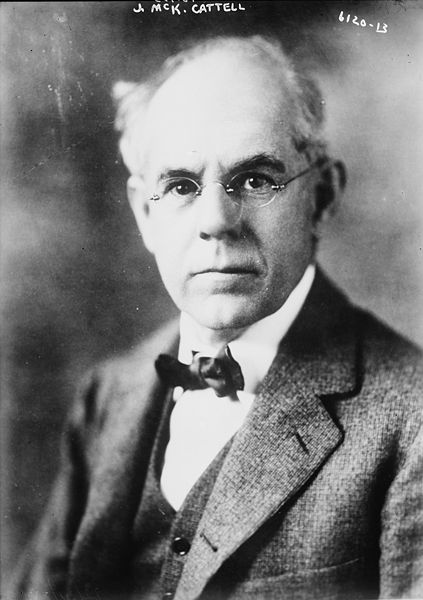
James McKeen Cattell (Library of Congress, n.d.).
Early Life:
James M. Cattell was born in 1860 in Pennsylvania. His father, William C. Cattell was the president of Lafayette College where Cattell began his formal studies in 1876 and thrived academically (Sokal, 2015).
Cattell’s father experienced anxiety issues despite his achievements and looked to his wife and Cattel to ease his anxiety. Cattell thrived in this close-knit family setting (Sokal, 2015). His family played a great role in his life and career.
Influences and Pursuits:
Cattell graduated with honours from Lafayette College (Woody & Viney, 2017). His undergraduate interests centred largely on literature (Woodworth, 1944). At Lafayette, Cattell’s scientific views were influenced by Francis A. March a teacher in mental philosophy and Francis Bacon, who emphasised the utility of knowledge and the collection of masses of empirical details (Sokal, 2015).
After graduating, Cattell spent two years in Germany, studying with philosopher Herman Lotze and then with Wilhelm Wundt in Leipzig.
Cattell attained a fellowship at Johns Hopkins in Baltimore. He became interested in laboratory science, enrolling in H. Newell Martin’s animal physiology course and G. Stanley Hall’s psychology course and worked in their laboratories. Cattell discovered he was skilful with instruments, devising and building apparatuses (Sokal, 2015). He began his psychometric investigations in Hall’s psychological laboratory and conducted experiments using a modified kymograph (Sokal, 2015).
Cattell left Baltimore to study with Wilhelm Wundt in Leipzig, after his fellowship was not renewed. He became the first American to earn a Ph.D. in experimental psychology from Wundt (Sokal, 2015).
Cattell then worked with Francis Galton in England. Galton’s interest in the measurement of bodily and mental attributes influenced Cattell greatly (Woody & Viney, 2017).
Cattell later returned to the United States to accept an appointment at the University of Pennsylvania (Woody & Viney, 2017), becoming the first psychology professor in the US.
Contributions to Psychology:
Cattell increased psychology’s recognition as a professional and scientific discipline. He established laboratories at the University of Pennsylvania and at Columbia University, building strong graduate programs in psychology with Thorndike and Woodworth being some of his students (Woody & Viney, 2017).
Cattell was interested in introducing quantitative methods into psychology, particularly for the measurement of individual differences (Woodworth, 1944). His research programmes focused on the development of mental tests, a term in coined. In Cattell’s day, measuring mental abilities was thought to be helpful for schools and industry. Cattell’s approach was later disputed, ending his career as a psychological tester. Alfred Binet’s different strategy to tests however showed more promise (Woody & Viney, 2017).
Cattell expressed his strong opinions on many issues, with his criticisms of key political and university officials leading to his dismissal from Columbia University (Woody & Viney, 2017).
Cattell worked as an editor of several journals including the journal Science, where he featured psychological articles alongside research from more established scientific disciplines and brought the work of psychologists to the attention of other scientists and the public. He alongside James Mark Baldwin founded two major journals in psychology, the Psychological Review and Psychological Bulletin. Cattell also created the Psychological Corporation to provide psychological expertise to business and industry and served as the 4th president of the APA (Woody & Viney, 2017).
References:
Library of Congress (n.d.). American psychologist, psychology professor, editor, and publisher James McKeen Cattell. Retrieved December 4, 2018 from https://commons.wikimedia.org/wiki/File:James_McKeen_Cattell.jpg#/media/File:James_McKeen_Cattell.jpg
Sokal, M.M. (2015). Launching a career in psychology with achievement and arrogance: James McKeen Cattell at the Johns Hopkins University, 1882-1883. Journal of the History of the Behavioural Sciences, 51, 5-19. https://doi.org/10.1002/jhbs.21764
Woodworth, R.S. (1944). James McKeen Cattell: 1860 – 1944. The Psychological Review, 51, 201 – 209.
Woody, W. D. & Viney, W. (2017). A History of Psychology: The Emergence of Science and Applications. (6th ed.). New York, NY: Routledge.
 Every mind and day
